What Is the Heat Resistance of Stainless Steel?
Stainless steel is often described as heat resistant, but that phrase needs careful definition. It may resist oxidation, retain strength, or survive brief heating without distortion. These are different performance measures. Understanding Stainless Steel And Heat requires examining grade, temperature, exposure time, atmosphere, and applied load.
The Outokumpu Stainless Steel Handbook reports melting ranges near 1,400–1,450°C for common austenitic grades, including 304 and 316. However, melting point is not a safe operating temperature. According to ASM Handbook, Volume 1, stainless steel strength can decline substantially before visible melting occurs. Grade 304 commonly provides useful oxidation resistance around 870°C in continuous service, while 310S is often selected for more demanding furnace environments. Exact limits depend on design conditions. They are not universal guarantees.
The Nickel Institute’s technical publication, High-Temperature Characteristics of Stainless Steels, explains how chromium supports protective oxide formation. Nickel improves structural stability in many austenitic grades. Still, repeated heating can cause scaling, distortion, sensitization, or embrittlement. A polished kitchen surface may look unchanged after a short exposure, yet its mechanical properties can already shift. That distinction is easy to miss.
In practical equipment reviews, engineers compare supplier datasheets with ASME or ASTM requirements. They also consider thermal cycling, airflow, weld quality, and contamination from sulfur or chlorides. A stainless component beside a furnace wall faces different risks from one inside an oxidizing chamber. The same grade may perform well in one location and fail early in another. This guide examines those variables, compares major stainless grades, and clarifies what “heat resistance” should mean in real applications. Some published limits remain approximate, so testing the actual design is still the safer judgment.
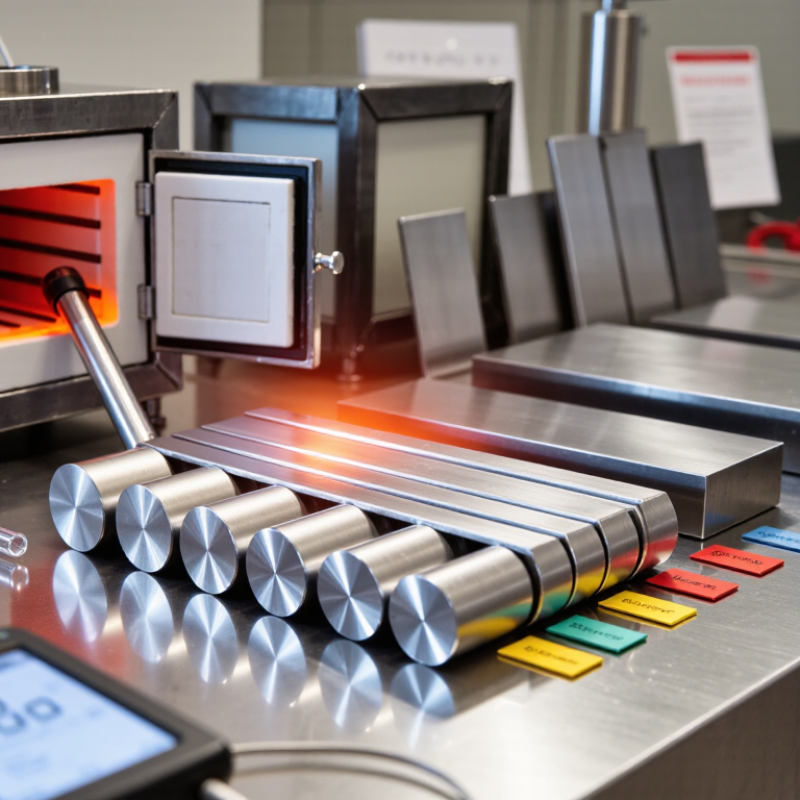
What Heat Resistance Means in Stainless Steel
Heat resistance in stainless steel means more than surviving a high temperature. It describes how well the metal keeps its strength, shape, surface protection, and corrosion resistance during heating. Time matters too. A component exposed to 800°C for ten minutes may behave differently from one held at 500°C for several months.
At elevated temperatures, stainless steel can soften, expand, discolor, or develop surface scale. Repeated heating and cooling create thermal stress, especially around welds, sharp corners, and thin sections. Some austenitic grades retain useful strength at higher temperatures, while other grades may lose hardness sooner. The surrounding atmosphere also matters. Moisture, oxygen, sulfur compounds, and trapped deposits can accelerate damage.
Temperature charts help, but they are not complete answers. A common workshop mistake is choosing a grade from its maximum temperature alone. Load, exposure time, surface condition, and fabrication quality must be checked together. I have seen clean-looking parts fail after repeated cycling, even when their peak temperature seemed acceptable. The failure was not dramatic at first: slight distortion, rough scale, then cracking near a weld. Testing a sample under realistic conditions is often wiser than trusting a single specification. Ask how hot, how long, how often, and under what atmosphere.
How Stainless Steel Responds to Rising Temperatures
Stainless steel does not have one universal heat-resistance limit. Its response changes with alloy, surface condition, applied load, and exposure time. A component may look unchanged while its strength quietly declines. Around 400–600°C, many common grades retain useful shape, but their mechanical performance decreases progressively. The exact limit depends on the design requirement, not appearance alone. Thin sections heat quickly. Thick sections respond more slowly.
Austenitic stainless steels often perform well at elevated temperatures, while ferritic grades may behave differently during repeated heating. At high temperatures, oxidation can create discoloration, scale, and surface roughness. Repeated heating and cooling can also cause expansion, distortion, or fatigue. Thermal expansion is easy to underestimate. Bright metal can deceive. Some grades may lose corrosion resistance after prolonged exposure between roughly 450°C and 850°C, especially when chromium carbides form near grain boundaries. This risk depends on composition, cooling rate, and service conditions.
In workshop inspection, temperature records matter more than color changes. A brief furnace peak is not equal to continuous operation. A loaded pipe, bracket, or heat shield needs separate evaluation because stress increases the consequences of softening. Engineers should check temperature, thickness, ventilation, pressure, and contact with corrosive gases. Welding history also deserves attention. I may sound cautious, but visual inspection alone is unreliable. Small-scale testing under realistic heating conditions can reveal warping, strength loss, or unexpected surface damage before installation.
What Is the Heat Resistance of Stainless Steel?
Stainless steel can remain serviceable at elevated temperatures, but its strength and oxidation resistance vary by grade. The chart shows approximate maximum continuous service temperatures in air; actual limits depend on atmosphere, load, exposure time, and fabrication condition.
Key point: Austenitic grades such as 304, 316, and 321 are commonly used up to about 870°C continuously, while 310S is designed for higher-temperature oxidation resistance and can reach approximately 1150°C in continuous service.
Factors That Influence Stainless Steel Heat Resistance
What Is the Heat Resistance of Stainless Steel?
Factors That Influence Stainless Steel Heat Resistance
Stainless steel does not have one universal heat-resistance rating. Grade chemistry, exposure time, mechanical load, and furnace atmosphere all matter. Chromium forms a protective oxide layer, while nickel improves structural stability during thermal cycling. However, oxidation resistance and strength retention are different properties. A component may resist scaling yet deform under pressure.
Published guidance in the ASM Handbook, Volume 1, reports approximate continuous oxidation limits near 925°C for many 18Cr–8Ni austenitic grades. Intermittent exposure can reach about 870°C, depending on cycling conditions. Higher-alloy austenitic grades may approach 1,100°C in oxidizing service. These figures are not design permissions. ASME BPVC Section II-D allowable-stress tables show that usable strength decreases sharply as temperature rises.
Carbon content also changes performance. Low-carbon grades reduce sensitization risk after welding, but they may not match stabilized grades during prolonged heating. Sulfur, chlorides, reducing gases, and deposits can accelerate corrosion. Thermal expansion creates additional stress, especially around rigid joints. Repeated heating and cooling can cause distortion or cracking.
Real installations often perform worse than laboratory data. I would treat published limits as starting points, not guarantees. Surface finish, weld quality, wall thickness, and airflow deserve inspection. A neglected detail can decide failure. Engineers should verify temperature, stress, atmosphere, and exposure duration against current material standards before selecting a grade.
Heat Resistance of Common Stainless Steel Grades
What Is the Heat Resistance of Stainless Steel?
Heat resistance varies significantly between stainless steel grades. Technical guidance from the ASM Handbook, Volume 13A, places 304 and 316 stainless steel near 870°C for continuous service in air. Intermittent exposure may approach 925°C. These figures are practical reference points, not guarantees. Welds, scaling, thermal cycling, and contaminated atmospheres can reduce performance. Grade 316 resists chloride corrosion better, but its molybdenum content does not make it a high-temperature grade.
Grade selection becomes clearer above 900°C. Stabilized grade 321 is commonly selected for repeated heating and cooling because titanium helps limit sensitization near welds. Heat-resistant grade 310S can operate around 1,050°C continuously and approximately 1,100°C intermittently, according to industry technical data and guidance aligned with EN 10088-1. Actual limits depend on furnace atmosphere, load, and component shape. Thin sheet may distort earlier than a thick support.
In field inspections, surface discoloration is often the first warning sign. Loss of strength may appear later. Oxidizing air, sulfur-bearing gases, and carbon-rich atmospheres behave differently. A stainless tube inside a clean laboratory furnace is not equivalent to one beside combustion gases. Engineers should check creep data, oxidation limits, and weld condition before approving a design. The published temperature may still be too optimistic. One overlooked thermal cycle can change the decision.
What Is the Heat Resistance of Stainless Steel? - Heat Resistance of Common Stainless Steel Grades
| Stainless Steel Grade | Common Classification | Approx. Maximum Continuous Oxidation-Resistant Temperature in Air | Approx. Maximum Intermittent Oxidation-Resistant Temperature in Air | Heat-Resistance Characteristics | Typical High-Temperature Uses |
| 304 / 304L | Austenitic | About 925°C
(1,700°F) | About 870°C
(1,600°F) | Good oxidation resistance and useful strength at moderately high temperatures. Prolonged exposure in the approximate 425–815°C range can cause sensitization in standard 304. | Food-processing equipment, exhaust components, heat exchangers, and general furnace fixtures. |
| 316 / 316L | Austenitic | About 925°C
(1,700°F) | About 870°C
(1,600°F) | Similar oxidation resistance to 304, with improved resistance to chlorides and many corrosive environments because of molybdenum. Its high-temperature strength is not as high as 309 or 310. | Chemical-process equipment, marine-related components, heat exchangers, and corrosive service applications. |
| 309 / 309S | High-alloy austenitic | About 1,095°C
(2,000°F) | About 1,000°C
(1,830°F) | Higher chromium and nickel contents provide better oxidation resistance and hot strength than 304 and 316. | Furnace parts, burner components, heat-treatment equipment, and high-temperature liners. |
| 310 / 310S | High-alloy austenitic | About 1,150°C
(2,100°F) | About 1,040°C
(1,900°F) | Excellent oxidation resistance and strong performance in many carburizing and oxidizing atmospheres. Long exposure in the intermediate temperature range may promote embrittling phases. | Furnace components, radiant tubes, combustion chambers, kiln hardware, and high-temperature containers. |
| 321 | Titanium-stabilized austenitic | About 870°C
(1,600°F) | About 900°C
(1,650°F) | Good resistance to oxidation and intergranular corrosion after welding or prolonged exposure in the sensitization range, due to titanium stabilization. | Aircraft exhaust systems, expansion joints, high-temperature piping, and chemical-process equipment. |
| 347 | Niobium-stabilized austenitic | About 870°C
(1,600°F) | About 900°C
(1,650°F) | Good high-temperature corrosion resistance and improved resistance to intergranular attack after welding or extended heating. | High-temperature piping, aircraft exhaust parts, pressure vessels, and chemical-processing equipment. |
| 430 | Ferritic | About 815°C
(1,500°F) | About 870°C
(1,600°F) | Good oxidation resistance in moderately high-temperature service, but lower thermal fatigue and weldability performance than many austenitic grades. | Appliance panels, automotive trim, exhaust components, and decorative heat shields. |
| 410 | Martensitic | About 705°C
(1,300°F) | About 815°C
(1,500°F) | Moderate oxidation resistance with useful strength and wear resistance. Strength and hardness decrease as service temperature increases. | Steam and gas-turbine components, valves, pump parts, fasteners, and moderate-temperature tooling. |
Note: The temperatures shown are approximate guidance values for oxidation resistance in air, not guaranteed design or pressure-vessel limits. Actual allowable service temperature depends on atmosphere, load, material thickness, thermal cycling, fabrication condition, corrosion, and applicable engineering standards.
